|
| |
|
|
 |
Science and Religion
|
|
|
|
|
|
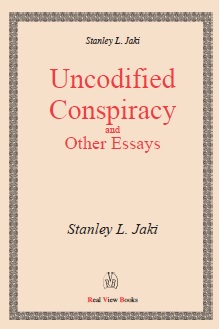
Uncodified Conspiracy
and Other Essays
This book is the seventh such collection of essays by the
author which deal mainly with science, or rather with misconceptions
about science's impact on other fields of inquiry.
Since a back-cover text can hardly contain as much as the
titles of the twenty-two essays reprinted in this book, let
just a few points be recalled here for the benefit of those who
have glanced through the table of contents. One of those
points, discussed in some detail in the introduction, is about
conspiracy as a more or less tacit effort to keep out of focus
the limitations of the scientific method, which is steeped in
the use of quantities.
The cultural impoverishment to which that conspiracy has
led is threatening Western culture with its demise. Would that
essays like those reprinted in this book might energize people
with good will and open minds.
By Fr. Stanley L. Jaki
ISBN 978-1-892539-05-2
•
x + 309 pages
•
softcover
•
$25

|
|
|
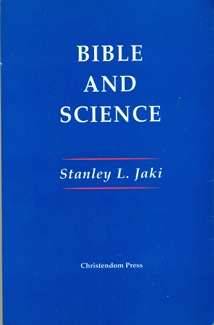
Bible and Science
On a cursory look, the Bible and exact science appear to be in a radical
conflict. But when both the Bible and the sciences are taken for what they
are, one can recognize a mutual dependence on both the conceptual and
historical levels. It is also shown that efforts to take the Bible for a
textbook on the history of the universe have been no less misplaced than are
scientific pretensions about its absolute origin. Science is given its full
due in this book, but so is the Bible as a record of God's revealed message
to man.
No less firmly vindicated is that human mind which is created in the
image of God. This point comes through with particular force in the chapters
on biblical miracles. Such and many other negative and positive aspects of the
relation between the Bible and modern science are carefully unfolded in this
book by a leading authority on science and religion.
By Fr. Stanley L. Jaki
ISBN 978-0-931888-63-8
•
vi + 218 pages
•
softcover
•
$20
|
|
|
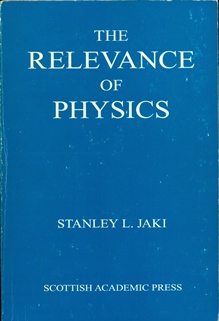
The Relevance of Physics
This book aims, in its author's words, to restore "that feature of the image
of physics which bespeaks the highly revisable character of its statements,
the never-ending course of its search, and the basic incompetency of many
of its conclusions in other important areas of human reflection".
Jaki argues that, contrary to past and present claims, physics has not solved
the riddle of living organisms, nor has it dispensed with metaphysics,
nor it has a solution of its own to the grave ethical problems raised by some
of its inventions.
In pondering the frailties of their forebears, physicist of our time
(and all scientists who stand in profound debt to physics) may better equip
themselves for their increasingly prominent role in shaping our culture.
Comments on the first edition:
"Jaki forged a powerful book"
—Atomic Scientist
"The appearance of this book is an event of no small importance and, as may be hoped,
of no small consequences for the future. It is one of the rare cases in scientific
literature where a competent scientist tries to delimit clearly and thoroughly the
boundaries within which his own science (physics) is valid. ... Jaki thinks
that a good knowledge of the history of science with all its failures and mistaken
convictions would be a lesson and of great help. It may be so, I suggest another recipe:
to make Jaki's book ... compulsory reading for all scientists, students, and professors."
— W. Heitler in American Scientist
By Fr. Stanley L. Jaki
ISBN 0-7073-0711-2
•
xii + 604 pages
•
softcover
•
$80
|
|
|
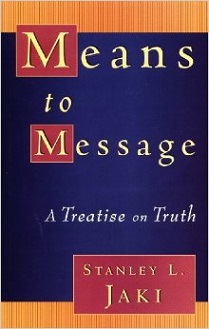
Means to Message: A Treatise on Truth
Every philosophy is a message. For conveying that message there has to be a tangible means, such as a book. Therefore, for the sake of a minimum of consistency, the philosopher's message or system should account in full for the reality of the means.
This book by Stanley Jaki aims at unfolding the consequences of this minimum for the main topics of philosophy. The necessary first topic is the objective reality of the means, or in general "objects". Any neglect of this will result, Jaki argues, in philosophical sleights of hand that endlessly breed one another. Jaki then removes some misconceptions about clarity, as usually identified with science, and demonstrates that science as such cannot account for the reality of the means that carries its message.
In keeping in focus the priority of the means over the message, Jaki takes up such further topics as free will, purpose, causality, change, and the mind. He thereby prepares the ground for discussing the universe, ethics, God, and miracles. Finally, he deals with history and with the question of whether humans are alone in the universe.
An important corrective to much of the work currently taking place in the field of philosophy, Means to Message provides a rigorous, highly original presentation of the claim that any consistent philosophical message must be steeped in a realist epistemology that is fully open to metaphysics.
By Fr. Stanley L. Jaki
ISBN 978-0-802846-51-8
•
233 pages
•
softcover
•
$29
|
|
|
![]() The Mirage of Conflict
The Mirage of Conflict
between Science and Religion
The claim is often heard that science and religion are in
irreconcilable conflict. However, when the essence of
science and the essence of religion are examined more
closely, this viewpoint may appear as simply a mirage.
The first and vital step in this investigation is to
understand that only physics (including astronomy,
chemistry and molecular biology) qualifies as exact
science. In this book the author explains how this is so,
and then explores what physicists themselves have
claimed physics to be. Next he considers what these
physicists have said as philosophers regarding physics,
and after that shows what their investigations of the
history of physics have revealed.
The result is that the function of numbers is seen as
the determinant factor in the nature of physics. If such
is the case, and as long as religion is viewed as a set of
propositions which are not subject to measurement,
which numbers make possible, then a conflict between
religion and exact science can only be a mirage.
A chapter on the ideologies grafted onto physics
provides further information on this crucial point. The
next to last chapter deals with the inclement climate of
opinion that prevents a fair consideration of these
points. The last chapter gives a concrete analysis of
some cases that often come up in debates regarding
science and religion.
By Fr. Stanley L. Jaki
ISBN 978-1-892539-13-7
•
viii + 87 pages
•
softcover
•
$12
|
|
|
Lectures
in the Vatican Gardens
This book is a collection of papers given at various
meetings of the Pontifical Academy of Sciences, all held in
its headquarters, Casina Pio IV in the Vatican Gardens. The
lectures deal with the relation of science and culture, with
the nature of exact science as different from other branches
of learning, and with evolution.
Their basic thrust is to show that there is no conflict
between a science and a religion (Catholicism in particular)
that are aware of their respective limitations. The latter
derive from the unique function of quantities versus the
function of all other words. While the latter can operate with
the phrase "more or less," the former cannot do so without
undermining the very definition of numbers, of integers in
particular.
The general title should not suggest that the contents and
claims of these essays reflect the position of the Vatican.
They reflect conclusions which the author reached after
pondering the relations of science and religion for half a
century.
By Fr. Stanley L. Jaki
ISBN 978-1-892539-11-3
•
xvi + 201 pages
•
softcover
•
$18
|
 |
Questions on Science and Religion
Endless questions have arisen about the relation of science
and religion. Disputes still rage and misunderstandings rule. On occasion some
claimed that harmony developed at long last between those two most disparate
subjects. In this book an internationally recognized authority on that relation
offers a key to fourteen important questions, concisely listed in the table of
contents. The key is derived from the author’s now more than four-decade-long
work, available in almost fifty books and five hundred articles. The key is the
unique status of quantities in the conceptual domain. The truth of any
proposition in science rests with quantitative procedures. And since quantities
are everywhere where there is matter, science has a universal competence. Yet
this competence appears very narrow when compared with the non-quantitative
conceptual domain, usually summed up as the domain of qualities or values.
Religion relates to this latter domain whose grasp gives, however, no competence
about the domain of quantities. Hence the mutual irreducibility of religion and
science. It assures respective autonomy to both. All misunderstandings about the
relation of science and religion arise from an oversight of their respective
conceptual competence. The two are equally needed, but in two very different
senses. This difference may disturb the scientistic reductionist as well as the
uninformed religionist. Anyone else will have to live in peace with the
difference which is between knowing how the heavens go, and how to go to heaven.
By Fr. Stanley L. Jaki
ISBN 1-892548-41-0
•
viii + 201 pages
•
softcover
•
$16.00
•
Question on Science and Religion is also available as an e-book from Gondolin Press ($9.99):

|
 |
Impassable Divide
Given the popularity of books on the relation of science
and religion, a close look on the subject may be in order. Much of that
literature provides no clear idea either about science or about religion under
discussion. It is argued in this book that the vagueness on the subject is due
to leaving both science and religion intentionally undefined.
The way out of this
confusion is sought in a strict definition of science which is based on its
exact form, physics, in which quantities form the touchstone of truth. Such a
definition of science puts it on one side of an impassable divide on the other
side of which lies a religion whose sole business is to assure an eternally
valid purpose for human existence, a strictly qualitative proposition. Since
conceptually there is no passage from quantities to qualities, the relation of
science and religion cannot be that of an integration or of an opposition. While
the human mind can grasp both domains, it cannot reduce one to the other. It
must, however, use to the full its ability to hover, so to speak, over the two
domains. The Introduction gives a general idea of the historical confusions and
complexities of that relation as well as of the only sound approach, which as
such eschews expectations of popularity.
By Fr. Stanley L. Jaki
ISBN 978-1-892539-02-1
•
vii + 108 pages
•
softcover
•
$12.00
|
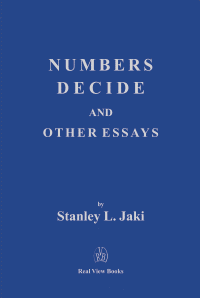 |
Numbers Decide
and Other Essays
This book, a collection of fifteen essays, takes its title
from a remark, "numbers decide", of Max Planck, one of the greatest physicists
of the twentieth century. Among competing physical theories that theory proves
indeed victorious whose predictions agree best with the numerical values of
experiments. Planck's phrase would have become even more memorable had he added
that outside physical or experimental science numbers decide very little. In
fact in the vast field of humanities they decide nothing substantial, a point
well to ponder in this age of science. This view sets the tone of the fifteen
essays that cover topics widely differing, yet equally relevant to some burning
questions of modern culture. Among these are the perplexities posed by
speculations about extraterrestrials, by cloning, by education, by the rude
awakening of an increasingly de-Christianized West to the reality of a crusading
Muslim world, and by anxious thoughts as to what the next thousand years may
have in store for mankind.
By Fr. Stanley L. Jaki
ISBN 1-892548-32-1
•
viii + 267 pages
•
softcover
•
$18.00
|
|
|
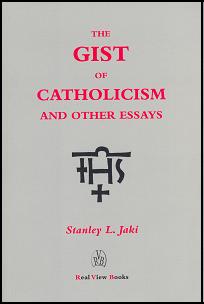
The Gist of Catholicism
and Other Essays
Of the nineteen essays of this book, the first was the last to be
written. Its theme, that continuity is the gist of Catholicism, can be
recognized throughout the other essays as well. This should be of no
surprise. The various parts of Catholic doctrine, and their
ramifications to policies to be followed by Catholics, have always
formed a strictly coherent whole. No part in it can be dislodged or
changed without a debilitating impact on all the other parts. This is
why the relation of faith, reason, and science has to follow a clearly
discernible path within the Catholic perspective; this is why
liberalism, insofar as its champions fail to set limits to it, is
incompatible with Catholicism. The limiting and directive factor of
Catholicism comes through most forcefully in the role of the papacy.
Four essays deal with the fact that in our times the grave questions
raised by the scientific manipulation of human life received unequivocal
answers only from the Catholic side. By the same token, as the
concluding essay shows, only the social teaching of the Catholic Church
has been able to steer a consistent course as the world has seen the
shift from socialism to consumerism.
By Fr. Stanley L. Jaki
ISBN 1-892548-16-X
•
vii + 253 pages
•
softcover
•
$16
|
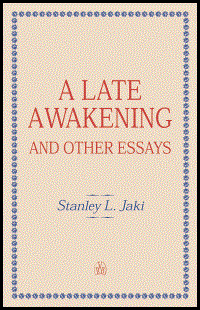 |
A Late Awakening
and Other Essays
This book is the eighth collection of essays by the
author that in a good part deal with science. The first essay deals with a
strange and very late awakening to the bearing of Gödel's theorem to physics.
The second is concerned with a similar though much earlier fact, namely,
Galileo's oversight of a wholly mistaken statement of Aristotle on the laws of
motion. The next five essays have for their topic, in part with an eye on
Duhem’s work, the role which Christ, or rather belief in him played and still
plays in a proper grasp of the history of science and even of brave utterances
about extraterrestrials. In chapter 8 attention is focused on the relation of
relativity theory to religion, with special reference to Einstein's own
statements, whereas the qestion of purpose as a problem in biology is discussed
in chapter 9. The next three chapters deal with the broader societal questions
of bioethics. Chapter 13 offers an analysis of the conversion to Catholicism of
Karl Stern, a noted Jewish psychiatrist. Chapters 14-15 deal with Chesterton,
whereas the thought of Thomas Aquinas constitutes the topic of the concluding
two chapters.
By Fr. Stanley L. Jaki
ISBN 0-9774826-4-2
•
viii + 261 pages
•
softcover
•
$18.00
|
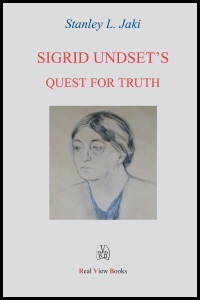 |
Sigrid Undset's Quest for Truth
Sigrid Undset is often spoken of as the
greatest novelist of the twentieth century. She, the winner of the Nobel Prize
for Literature in 1928, may also be one of the greatest converts during
the same century.
Contrary to the cliché, Sigrid Undset did not convert because of her fondness
for the Middle Ages. In this age of one-parent families and "partner"
relationships, it may be most instructive to recall that she converted because
her disastrous marriage opened her eyes to what it means for a woman to be a
mother and to what children really are, beings created by God for an eternal
destiny. That meaning Sigrid Undset found to be anchored in the reality of the
Catholic Church insofar as its Founder, Jesus Christ, was truly the Son of God.
She then became a staunch defender of the Catholic faith through many essays
that have been neglected by her literary critics, most of whom judged her on
the basis of her novels, while largely ignoring their true gist.
Those essays convey with particular force Sigrid Undset's quest for Truth and
her holding fast to it, once she had embraced it with great joy.
The book contains the text of Sigrid Undset's two pivotal essays,
not previously available in English, Efterskrift (Postscript),
translated by Marianne Aga, and My reasons to convert, translated by
Fr. John H. Halborg.
A booklet that contains another text of Sigrid Undset,
Reply to a Parish Priest,
can be found here.
By Fr. Stanley L. Jaki
ISBN 978-0-9790577-6-2
•
viii + 296 pages
•
softcover
•
$19
|
|
|
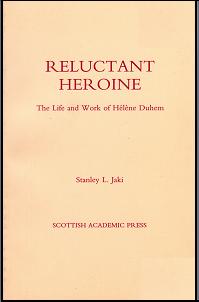
Reluctant Heroine:
The Life and Work of Hélène Duhem
The life-story told in this book centers on the almost forty years of
delay that preceded the publication, between 1954 and 1960, of the
second five volumes of Le système du monde of Pierre Duhem
(1861-1916). A genius in theoretical physics and in the philosophy of
physics, Duhem became through that work, easily the most original
scholarly achievement by a single author in modern times, the pioneering
discoverer of the medieval origins of Newtonian science. Those second
five volumes might still be in manuscript had it not been for the
heroically persistent efforts of Hélène (1891-1974),
Duhem’s only child.
Stanley L. Jaki has earned international renown for his many books on
the history and philosophy of science. They include monographs on
Duhem’s life and work, including his marvelous landscapes. On the basis
of a so far unpublished correspondence among the story's chief
protagonists, he now probes into a stunning lack of objectivity among
leading historians and philosophers of science.
By Fr. Stanley L. Jaki
ISBN 0-7073-0724-4
•
xii + 335 pages
•
softcover
•
$12
|
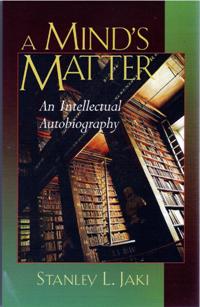 |
A Mind's Matter:
An Intellectual Autobiography
In writing A Mind's Matter one of his generation's finest
philosophers looks back at his own scholarship and the
intellectual framework that produced it - not least his
staunch belief in the crucial role of religious
convictions in academic thought.
Stanley Jaki's
explosive productivity canvasses a wide range of
relevant topics, most notably the history of science,
and has earned him such signal honors as the Gifford
lectureship and the Templeton Prize. A Hungarian by
birth, Jaki has since 1950 lived in the United States,
where one's religion is supposed to be a strictly
private affair. Yet as a Catholic priest of the
Benedictine Order, Jaki has never made secret his
dislike of the "rule" that expects to eliminate
religious factors from the so-called academic equation.
To his mind those factors matter very much
indeed.
In this powerful intellectual autobiography, Jaki reflects on the course of his thinking, asking in what sense the religious factors he holds dear can also promote scholarship, particularly in the sensitive field of science and religion. The answer is set forth in a combination of topical and chronological meditations that will be of great value to anyone pursuing academic work today.
Ordering this book, you will also receive the two additional chapters Fr. Jaki
wrote, covering his later years. A complete list of Fr. Jaki's publication
is maintained online, and can be found
here.
By Fr. Stanley L. Jaki
ISBN 0-8028-3960-6
•
xiv + 309 pages
•
softcover
•
$18
|
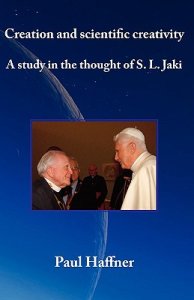 |
Creation and Scientific Creativity:
A Study in the Thought of S.L. Jaki
Father Stanley Jaki (1924-2009) was one of the great thinkers of the twentieth century and his contribution to Catholic thought and culture has been profound, especially regarding the relationship between science and religion. This work focuses on the close link joining science and Christianity, despite the differences between them. Through his study of modern science, theology, and history, Stanley Jaki showed faith and reason are not mutually exclusive. The problems arise because of those ideologies which seek to eliminate God from the ultimate equation. Jaki highlighted the Christian origins of the modern natural sciences. He showed that the concept of the cosmos as both contingent and rational, together with the acceptance that God could work through secondary causes, providing the unique environment for the natural sciences to flourish, from the Middle Ages onwards. He explored the crucial role played by belief in creation out of nothing and in time, reinforced by faith in the Incarnation, in enabling this birth of science. This book contains the firest systematic treatment of the ideas of the late Stanley Jaki, and is the only complete work, with an entire bibliography, approved by him during his lifetime.
By Fr. Paul Haffner
ISBN 978-085244-454-2
•
xiv + 329 pages
•
$25
|
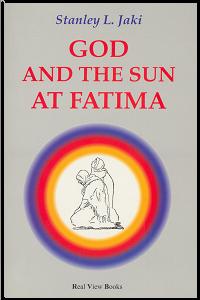 |
God and the Sun at Fatima
God writes straight along crooked lines, so goes a Portuguese proverb, which sums up the story unfolded in this book.
The story is about the far from adequate attention which writers on Fatima paid to the eyewitness accounts of what is usually referred to as "the miracle of the sun."
Contrary to the stereotype claim that the sun "danced" over Fatima on October 13, 1917, something else did that "dancing." The great majority of eyewitness accounts, our sole source of information about what was observed on that day in Cova da Iria, refer to thin clouds that covered the sun as it "danced."
Therefore it should seem logical to approach the miracle of the sun as a meteorological miracle and do thereby justice both to science and religion.
As a true miracle, "the miracle of the sun" put a divine seal on a message that determined in the long run and in a "crooked," that is, most unpredictable, way the outcome of twentieth-century world history.
By Fr. Stanley L. Jaki
ISBN 1-892548-C4-6
•
ix + 381 pages
•
softcover
•
$25
|
|
|
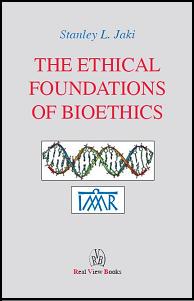
The Ethical Foundations of Bioethics
This book offers eleven essays on various aspects of bioethics, a most
hotly contended subject of our times. Like in any other subject, here
too it is the focusing on the foundations that controls all discourse
and arguments. This is why the book begins with the question about the
true origin of man and with the purpose of assuring his health.
Attention is then drawn to life's twofold defense, natural and
supernatural. Chapters 4-7 deal with bioethics proper, with its need
for consistency, with its truly ethical foundations, with its essence as
tied to the essence of the human being, and with its future as being the
soul's future. In the next three chapters a view is taken, in turn,
of the metamorphoses of human dignity, of the parasitical aspects of
modern society, and of the, unfortunately, vain hopes that a dire need
for proper bioethics would be widely embraced and implemented. The last
chapter calls attention to Mary's role in the Incarnation as the very
factor which in true believers in Christ forms, though often unbeknownst
to them, the reason of their visceral opposition to abortion. Time and
again is the passage in the Book of Sirach recalled that as long as man
is willing to battle for truth, the God of truth will battle for him.
The Spanish translation of this book can be found
here.
By Fr. Stanley L. Jaki
ISBN 978-1-892539-00-7
•
viii + 136 pages
•
softcover
•
$12
|
|
|
Theology of Priestly Celibacy
Christian theology is a reasoned discourse about what God revealed in Christ. Otherwise theology turns into a device to accommodate man as a being who, not having been crushed by an original Fall, does not stand in need to be redeemed. Redemption was the work of Christ's priesthood, based on his theandric fullness, of which his celibacy was an integral part. Christian priesthood sprang forth from Christ's eternal priesthood. It is in this light that this book deals with the christological and apostolic origins of priestly celibacy and with the unrelenting adherence to it by those who held high that fullness with no failure whatsoever.
This age of ours, greatly suffering from its obsession with sex, needs celibate priests fully conscious of theological truths as greatly different from and far superior to fashionable trends in philosophy, psychology, and sociology. Priestly celibacy is not a negotiable option but a theological cogency. This is borne out even by the Eastern Orthodox practice and predicament.
A contrast is drawn between the views which truly great figures of the new theology, such as Moehler, Scheeben, and Newman, held on priestly celibacy and views embodied in some latter-day theological rhetoric on it.
The book concludes on the theme that inasmuch as the priest, in likeness of Christ, is an altar, he is also Christ's witness. What the priest witnesses must therefore have truth for its principal object. In the priest's celibacy this witness of his reaches its existential fullness.
By Fr. Stanley L. Jaki
ISBN 0-9318886-8-9
•
vi + 223 pages
•
softcover
•
$14
|
|
|
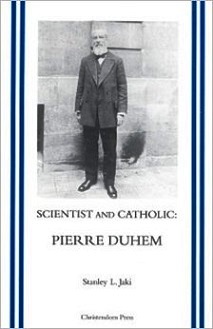
Scientist and Catholic: Pierre Duhem
Pierre Duhem (1861 -1916) was one of the few true geniuses around the turn of the century. He excelled in theoretical mechanics and thermodynamics, wrote the most incisive philosophical interpretation of the meaning of physical laws, and discovered, to his own great surprise, the medieval, Christian origins of Newtonian physics. The additional fact that Duhem was an exemplary Catholic should long ago have turned him into a legend on Catholic campuses.
Duhem’s extraordinary intellectual stature has been far better recognized in secularist academic circles. There, however, the witness he gave about his deeply lived and thoroughly argued Catholic faith is readily brushed aside with condescending remarks. Duhem remains for those circles an “uneasy genius.” Duhem’s memory makes no less uneasy Catholic intellectuals, eager to please their secularist counterparts in control of the academic world.
In the first half of this book, Father Jaki presents a systematic portrayal of the dramatic life and work of Duhem, the Catholic scientist. In the second half of the book he offers twenty-seven selections—some of which appear here in English for the first time—from Duhem’s writings, as illustrations of the perfect unity in him of science and Catholic faith.
In deference to Duhem’s love of France and Paris, which he always considered his real home, this book was first brought out in French under the title, Pierre Duhem: Homme de science et de foi (Paris: Beauchesne, 1991).
By Fr. Stanley L. Jaki
ISBN 0-931888-44-1
•
278 pages
•
softcover
•
$21
|
|
|
|
|Home|
|Biography|
|Science and Religion|
|New Editions|
|Reprint Series|
|Reprints cont|
|About Newman|
|Newman Works|
|Booklets|
|Booklets cont|
|Theology|
|Theology cont|
|Prayers|
|Various|
|Contact Us|
|
|